REVIEWS

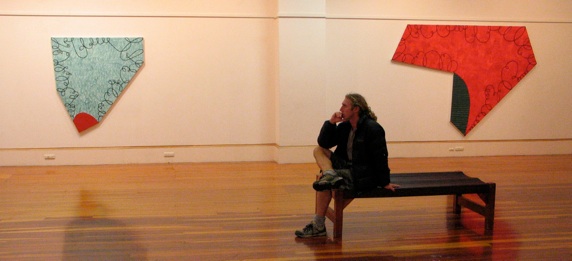
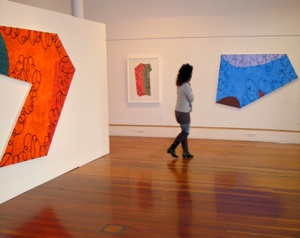
“Brightland” and “Lake-light”, WANAKA series, by Rob Piggott.
"Summerland", Rob Piggott (Community Gallery)
"Summerland" is the first of two Rob Piggott exhibitions at the Community Gallery, with a second due next month.
Two parallel series are presented in the current exhibition. The first, the "Daybreak Series", consists of abstract pastel works exploring the borderlands between night and day, light and dark.
Brightness erupts from the centres of the paper, pushing at rigid linear edges beyond which lies darkness.
The colours are vivid and violent, and there is a clear expression of the forcefulness with which the two halves of existence push at each other's boundaries while remaining simply two aspects of the same world.
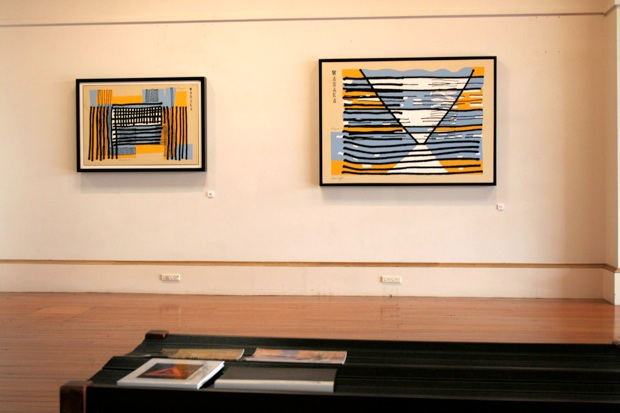
The remaining works - the "Wanaka paintings" - might almost be considered abstract impressionism, if such a term was not a contradiction. Grid-like black lines overlay simple forms in a gentle and limited palette of blue, white and gold, all presented on plain canvas.
The colours and shapes imply the landscapes of Central Otago, and a strong sense of place and light emerges from these minimal elements.
The intent is to provide memory-triggers of the landscape, or alternatively to remain as sheer artistic experiments in abstraction.
On both accounts these works succeed; they are aesthetically pleasing in themselves and also strongly evocative of the light and land around the lake.
-
-James Dignan
http://www.odt.co.nz/entertainment/arts/194811/art-seen
Arts
© Allied Press Limited 2012. All the material on this page has the protection of international
copyright. All rights reserved.
________________________________________________________________
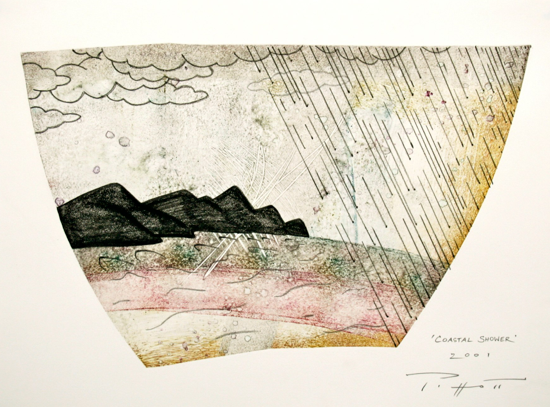
“Coastal Shower”, by Rob Piggott
Rob Piggott, "Landmarks", Rocda Gallery
Rob Piggott's exhibition "Landmarks", at Rocda Gallery, is composed of works on paper produced between 1999 and 2001.
These works have a dualistic quality: at once abstracts and landscapes, the subject matter near to and far from the viewer, the artist's technique both light and bold.
The dates of these works take nothing from the contemporary feel; they rather add to the historical and monumental associations of landmarks.
Piggott's works are all of irregular shape, the background a monoprint on paper, with charcoal and pastel used in bold lines and blocks in the foreground.
References to New Zealand in the titles are combined with geometric shapes, earthy colours and patterned lines, so as to evoke, simultaneously, the local and the global.
This mixture of near and far (as far as you wish to go) is highlighted in Piggott's use of black lines in parallel patterns.
We view works like Sunset on the Mountain or Taieri Evening from above, looking down on tracks or paths, at the same time as we peer through a fence or window.
In other works, such as Marsh Grass, these marks become unmistakably a part of the land.
Piggott has put together a solid exhibition of works that shows a range of personal responses, yet openly invites the viewer to find their own associations.
( http://www.odt.co.nz/entertainment/arts/86235/art-seen-abstracts-and-landscapes )
------------------------------------------------------------------------------------------------------------
ARTICLES:
“From wonder into wonder existence opens” (Lao Tzu):
The work of Robert Piggott
by Dr. Cassandra Fusco
‘TAKAHE’ no.70, 2010
ROBERT PIGGOTT,
“An Exploration of Consciousness”
by Dr Cassandra Fusco
ASIAN ART NEWS
Sept/Oct 2010
READ: ASIAN-ART-NEWS-RP-2010.pdf
Art seen: Abstracts and landscapes
Home » Entertainment » Arts
Otago Daily Times; Thu, 17 Dec 2009
Erin Driessen takes a look at the latest exhibitions around Dunedin.
--------------------------------------------------------------------------------------
OTAGO DAILY TIMES
Arts, Feature Article by Charmian Smith
GETTING BENEATH THE SURFACE JANUARY 27 2011
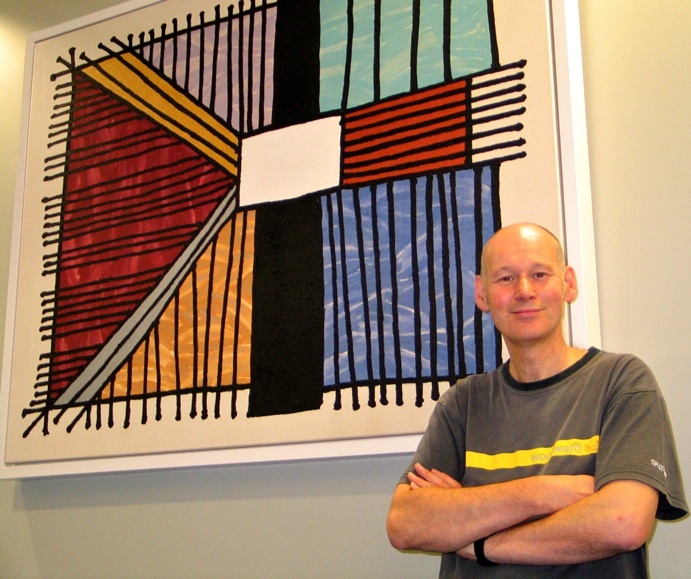
Rob Piggott
Published on Otago Daily Times Online News (http://www.odt.co.nz)
Getting beneath the surface
By Charmian Smith
Created 27/01/2011 - 04:55
If you're waiting at Dunedin International Airport in the next
couple of months, take a look at the art on the walls.
Charmian Smith talks to Rob Piggott, the current "Artist in
the Terminal."
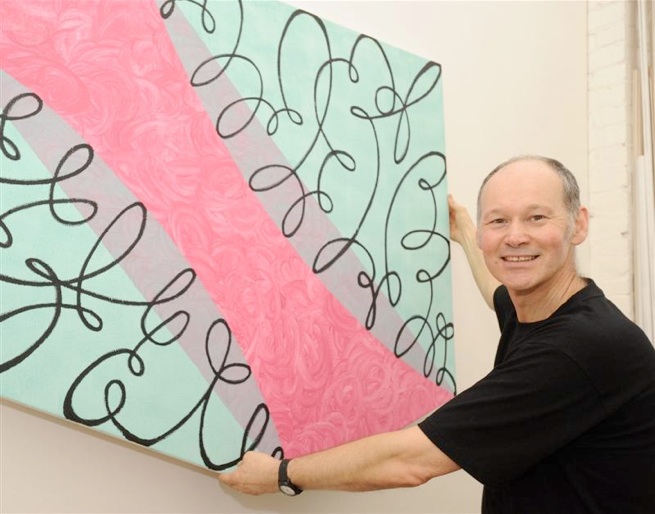
Climb over a pile of carpets on the top floor of one of the historic warehouses in Cumberland St, in Dunedin, and you'll come to artist Rob Piggott's airy studios and store rooms.
Stacks of large canvases, brightly coloured works on the walls, and towers of drawers holding works on paper
glow in the gentle south light from the skylights.
On a low table, Chinese brushes large and small, plain and ornate, are laid out intriguingly in rows.
Piggott has been working as an artist for more than 30 years, and despite teaching an art, music and language programme in the special needs learning centre at Kaikorai Valley College, juggling family life, and caring for his mother who suffered from Alzheimer's, playing music (vocals, and guitar) and studying for a masters degree, he has been prolific in his art.
"It takes enough sometimes for me just to get into the studio and get work done, when maybe it would seem even impossible to do that," he said.
"I've always managed to keep my art practice going, but to make it into the marketplace - it's not my strength marketing my work."
He has shown work in several Dunedin galleries since his first exhibition in the Otago Museum in the late 1970s.
However, several things have happened in the past few years that have brought wider attention , and enabled him to spend more time at his work, he says.
Among them are his children growing up and leaving home, his mother died a year ago, and he is reducing his teaching hours, but more importantly, he was invited to show his work at the International Art Fair in Taiwan, Art Taipei 2007 with eight other New Zealand artists.
Since then he has had several exhibitions there, and sold more work than he has in New Zealand, he said.
Last year articles on him and his work, written by Dr Cassandra Fusco of Christchurch, appeared in Takahe, a New Zealand literary magazine, and the international magazine Asian Art News.
For the next two months, he is "Artist in the Terminal" at Dunedin International Airport.
He put forward a hanging proposal for 15 large abstract paintings in various places around the building.
"I think they will work beautifully in a space like this. They will become part of the architecture and I believe they will generate a real feeling to what in some ways is a rather sterile, functional environment. I'm hoping it will give a certain kind of presence to the airport," he said.
The works on display will be from various series dealing with "lines, loops and light".
Some will refer to a landscape, like the large blue and yellow one entitled Wanaka that will hang on the landing.
It relates to a personal memory of Wanaka and is about light and ripples on water, but it is not important that anyone understands his experience and they can bring their own responses to it.
"For me it's important that it's coming from my own life, but once it leaves me I want it to be
open."
When he first became an artist he made an agreement with himself that art would always be an exploration, rather than a production of works to sell, he said.
"I keep with my own vision, whatever that is. It's quite expansive. I don't have a signature style and for that reason I find it difficult to market my work."
He works in series, challenging himself to explore an idea as fully as possible without repeating or rehashing it.
"That's fairly hard to do sometimes with abstract work that is fairly minimal. But in a sense it's a refreshing challenge, quite an exhilarating challenge to find there are still other possibilities within something that has fairly strict limitations to it."
As a teacher he has done representational work - "the nudes and the vases of flowers" - he says, and although he enjoys it, abstract work is where he feels at home.
"There's something about abstract art that draws me into wanting to get beneath the surface of things. There are a number of layers to a painting. To me painting is primarily a visual experience rather than a cerebral one. It's not just about meaning, although that's in it.
"I believe the nature of meaning is transitory - what had meaning for you when you were a child is not necessarily meaningful to you now."
While meaning may be an important part of art, he prefers to go behind the surface, he says.
"I want it to be a visual experience, and to a certain extent a meditative experience, because, when you are in a visual state, your mind settles and becomes quiet. I guess that's why I've chosen painting rather than writing. I don't want to use words: I want to use silence," he said.
"I want my painting to have a sense of simplicity. I think it's connected to truth, and I think that's why I like to work in an abstract way rather than creating an illusion.
Why the terminal?
The Artist in the Terminal programme aims to enhance people's experience while they are in the building,
according to John McCall, chief executive, Dunedin International Airport.
People can have their most joyful or saddest experience at an airport, or they can be bored, stressed or
apprehensive, he says.
Displays such as the Otago Museum's on the first floor and art work from the Artist in the Terminal programme, are intended to help people relax by providing something unexpected and different in an airport, he says.
They had received requests from artists to hang work in the terminal from time to time, but they didn't want it to become a community gallery, so they set up the programme, inviting proposals from artists to display their work for a period.
"We've had art in the stairwell, and some predetermined positions, depending on what the art is and the size, but Rob's proposal is more expansive than in the past. He's the first abstract artist we've had," Mr McCall said.
Rob Piggott's "Presence: loops, lines and light" will be on show from January 27 until March
25.
Arts
© Allied Press Limited 2007. All the material on this page has the protection of international
copyright. All rights reserved.
Source URL (retrieved on 27/01/2011 - 15:49): http://www.odt.co.nz/entertainment/arts/145465/getting-beneath-
surface
Links:
[1] http://www.odt.co.nz/files/story/2011/01/rob_piggott_4d3fa3a7c2.JPG

"SUMMERLAND"
Rob Piggott
Dunedin Community Gallery, 8 - 21 January 2012
Finding the Loophole
Dunedin Community Gallery, 20 Princes Street
15-29 February
Rob Piggott’s “Loop Series”, works 1999-2012
You can’t help but be impressed by the bold nature of the “Loop Series”, a collection of paintings by Dunedin-based artist Rob Piggott.
Large canvases, cut into interesting but seemingly senseless shapes, feature bright blocks of colour - scarlet reds, azure blues, mustard yellows and pale pinks - juxtaposed with spiraling lines that swirl energetically across abstract space. The name of the series is apt, as each painting within the group displays the looping curls that have featured in one form or another throughout Piggott’s career.
It began as a fascination and experimentation with shapes - which marked Piggott’s paintings from the 1980s - but only during the 1990s did this evolve into a fully-fledged focus on the spiral shape. Representative of the fluid rhythm and movement of life, the spiral emerged as a significant motif in Piggott’s artwork, eventually transforming into the quirky loops seen in his current exhibition. Piggott spends a great deal of time shaping his canvases into their unique forms and outlines before actually painting on them, then uses acrylic and oil-stick on canvas to achieve the look and colour of the “Loop Series”.
The response to the series has been mixed. Piggott notes that among the many positive reviews, he at times receives comments that remark disparagingly on the simplicity of the paintings. However it is this simplicity that he strives for in his work. Indeed, it is one of the three self-proclaimed elements of his art, alongside “emotional content” and “patience”. Asked to explain what he means by “patience” Piggott explains that the thought process behind his work is far more complex than it may at first seem. Subtlety is what makes his paintings so unique and intriguing, and it takes patience - a lot of looking, Piggott remarks with a chuckle - for people to see the emotional thrust behind what may at first appear to be “standard” artwork. In particular, Piggott refers to the act of viewing his paintings as a kind of “meditation”; and indeed, absorbing yourself in the abstract curves and coils that spiral across such carefully crafted canvases does appear to be a sort of visual experience of patience; a quieting exploration for meaning.
And exactly what meaning is there to be gleaned? While he strongly believes his art should always be open to the interpretation of the individual viewer, Piggott has his own ideas on what his energetic loops convey. The visual exploration of human consciousness and sub-consciousness is expressed through conflicting colours and twisting lines that hint at the hidden turmoil of the mind and of human life, beneath the veneer of civility and sensibility often shown to the world. It is this mask of so-called normality that Piggott sees as being visually represented by a perfectly straight line, the ultimate visual demonstration of precision and control.
The exhibition displays an incredible thirteen years’ worth of Piggott’s loop work. Whether or not he will continue to work with this same motif is for the moment uncertain, though Piggott emphasizes that he would never close himself off completely from the idea. With a good-natured shrug, he explains that after all, those constantly looping lines have “never-ending potential, like everything”.
By Beaurey Chan.
This article first appeared in Critic Issue 1, 2012.
http://www.critic.co.nz/culture/article/1567/finding-the-loophole